Flatpack, Freight or Dealer Floor? What a Trike Costs to Get and to Keep
The purchase price of an electric trike is the easy number. What follows it depends on how the machine arrived and who within an hour of home will service it.
Choosing, storing and maintaining electric three-wheeled cycles for adult riders in a hot, humid, flat coastal region
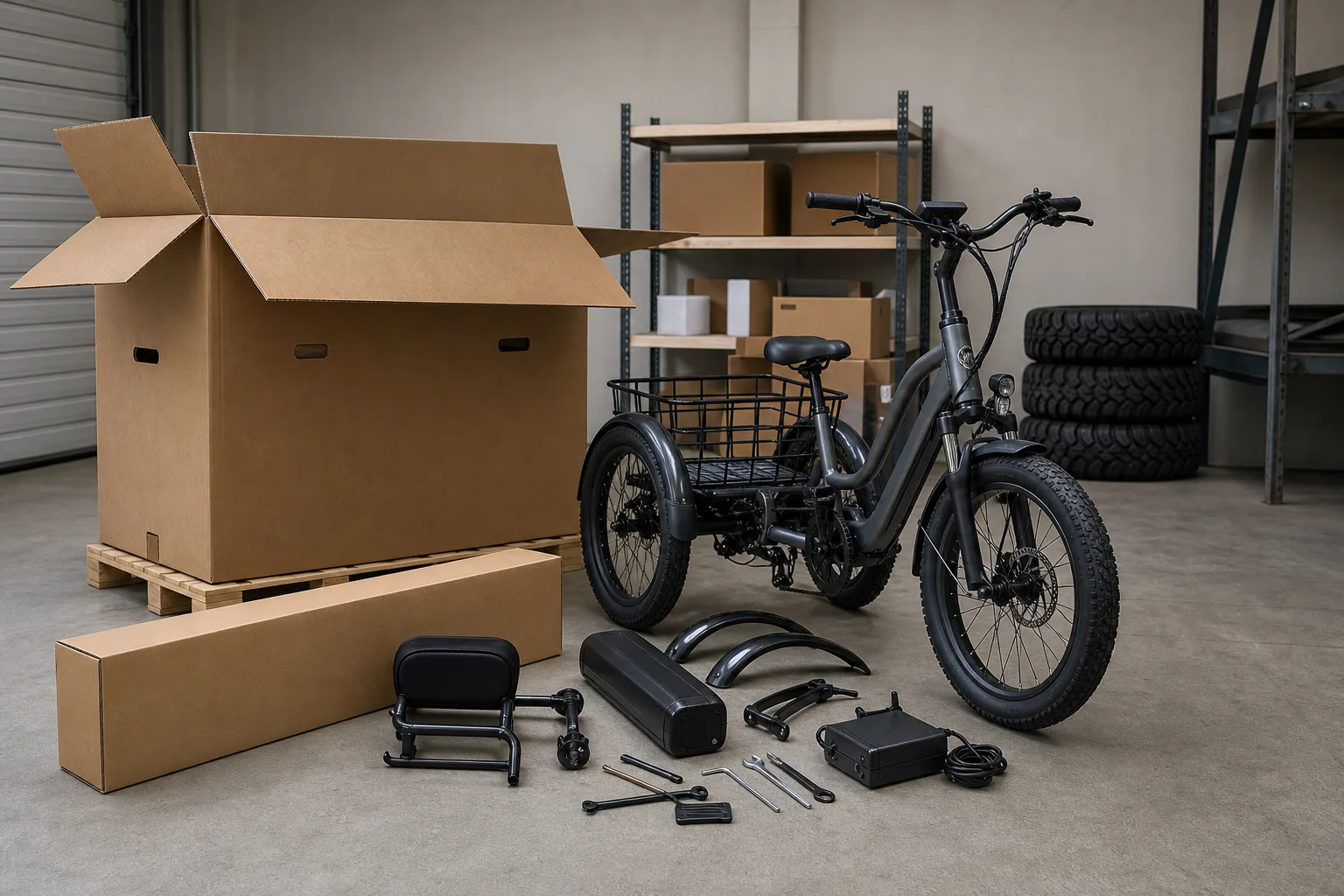
- Parcel versus freight delivery Flatpack trikes ship in one or two parcel-carrier boxes with major assembly left to the buyer, while crated trikes arrive by freight truck with a liftgate and need a clear place to unload. Confirm the delivery method before ordering, because a liftgate drop needs a hard, level surface and someone present to sign.
- Batteries ship separately Lithium packs move under ground-only transport rules, so the battery often arrives on a different day than the trike. Plan for the machine to sit unridable for a week if the two shipments split.
- Trike assembly rates Shops frequently charge more to assemble a trike than a bicycle because it will not sit in a standard repair stand. Get that quote in writing before the crate is on its way.
The sticker is the least interesting number attached to an electric trike, because it is fixed, published, and easy to compare across a dozen browser tabs. What follows it is neither fixed nor published. A careful reader works backward from the second-order costs, replacement battery, tires that fit an odd rear axle, pads for a brake nobody stocks, and lets those numbers decide which purchase price is actually the cheap one. Two trikes separated by several hundred dollars at checkout can be separated by a multiple of that over five years of riding on a flat, salted, humid coast.
Three ways the machine arrives, three different bills
The lowest band is the flatpack that comes by parcel carrier in one or two boxes, with the rear axle, fenders, seat and often the handlebar controls left for you. The middle band is freight delivery, a crated trike on a liftgate truck, mostly assembled, wheels trued at the factory and the battery shipped separately under ground-only rules. The top band is a dealer-assembled machine you ride away from a shop floor. Each band buys something different: the first buys price, the second buys a mostly-square wheel, the third buys a person who will answer the phone in March.
The assembly gap is not just labor. A flatpack trike arrives with cable tension set by a packer, brake pads seated against rotors nobody has bedded in, and a rear differential or solid axle that may need shimming you cannot see from a photograph. Budget either a weekend with a torque wrench and a repair stand, or a shop's assembly rate, which shops often quote higher for trikes than for bicycles because the machine will not stand in a normal work stand. Ask that rate before ordering, not after the crate is in the driveway.
The battery is the recurring number that matters
Lithium packs are rated in charge cycles, and the honest way to read that rating is as a range rather than a promise, since heat, depth of discharge and storage state all move it. On a hot coast, a pack that lives in a carport ages faster than the same pack in a conditioned closet, and the practical result is a replacement conversation after a few hundred full cycles rather than the number on the spec sheet. What a careful reader checks is not the cycle count but the replacement path: is the pack a common case with a listed part number, or a proprietary shell that only one importer sells? A discontinued pack shape can strand an otherwise sound trike.
Price the replacement before you buy the trike. If the seller will not quote a battery as a spare part, that silence is the answer. The Consumer Product Safety Commission is the federal body responsible for e-bike and battery safety in consumer products, and packs sold as separate replacement items are easier to trace, certify and ship than one-off cells rewrapped by a third party. A trike with a battery you can reorder on a Tuesday is worth paying more for than one with a slightly larger pack and no listed replacement.
Tires, pads and the hour-radius question
Rear tires on an adult trike wear unevenly because the machine does not lean, and the outside edge of the loaded wheel scrubs on every turn. Expect to replace rears more often than fronts and to hunt for the size, which on many trikes is a twenty-inch that hardware stores do not carry. Brake pads are cheap in absolute terms, mechanical disc pads especially, but only if the caliper is a standard pattern. Salt air corrodes rotors and pistons faster than inland riders expect, so pads and rotor surfaces become a seasonal check rather than an annual one.
Then the hour-radius question, which is the one that separates the three price bands more than anything on the invoice. Call three shops within an hour and ask whether they will work on a hub motor they did not sell, whether they will handle a proprietary controller, and whether they will lift a sixty-pound trike onto a bench. Some will do everything but touch the drive system, which is workable, since brakes, tires and bearings are the recurring work anyway. A yes from even one shop changes the math on a flatpack considerably.
Write the five-year total on paper before you choose a band: purchase, assembly, one battery, two sets of rear tires, pads twice, and a shop visit or two. The band that wins that arithmetic is rarely the one that wins the checkout comparison, and knowing which is which before the crate ships is the whole exercise.