The two-second problem
Most riders switch because of the moment at a stop sign when one foot is down and the frame is leaning against a bad joint. A trike removes that moment entirely.
Covers electric three-wheeled cycles for adult riders on flat streets, levee paths and gravel shoulders in south Louisiana
Most riders switch because of the moment at a stop sign when one foot is down and the frame is leaning against a bad joint. A trike removes that moment entirely.
A bicycle leans into a turn without being asked; a trike cannot lean, so the turn is taken by tire grip alone. Speed has to come off before the corner rather than during it.
The rear wheel on the inside of a turn gets light well below any speed that feels fast. Finding that threshold deliberately in an empty parking lot is worth an afternoon.
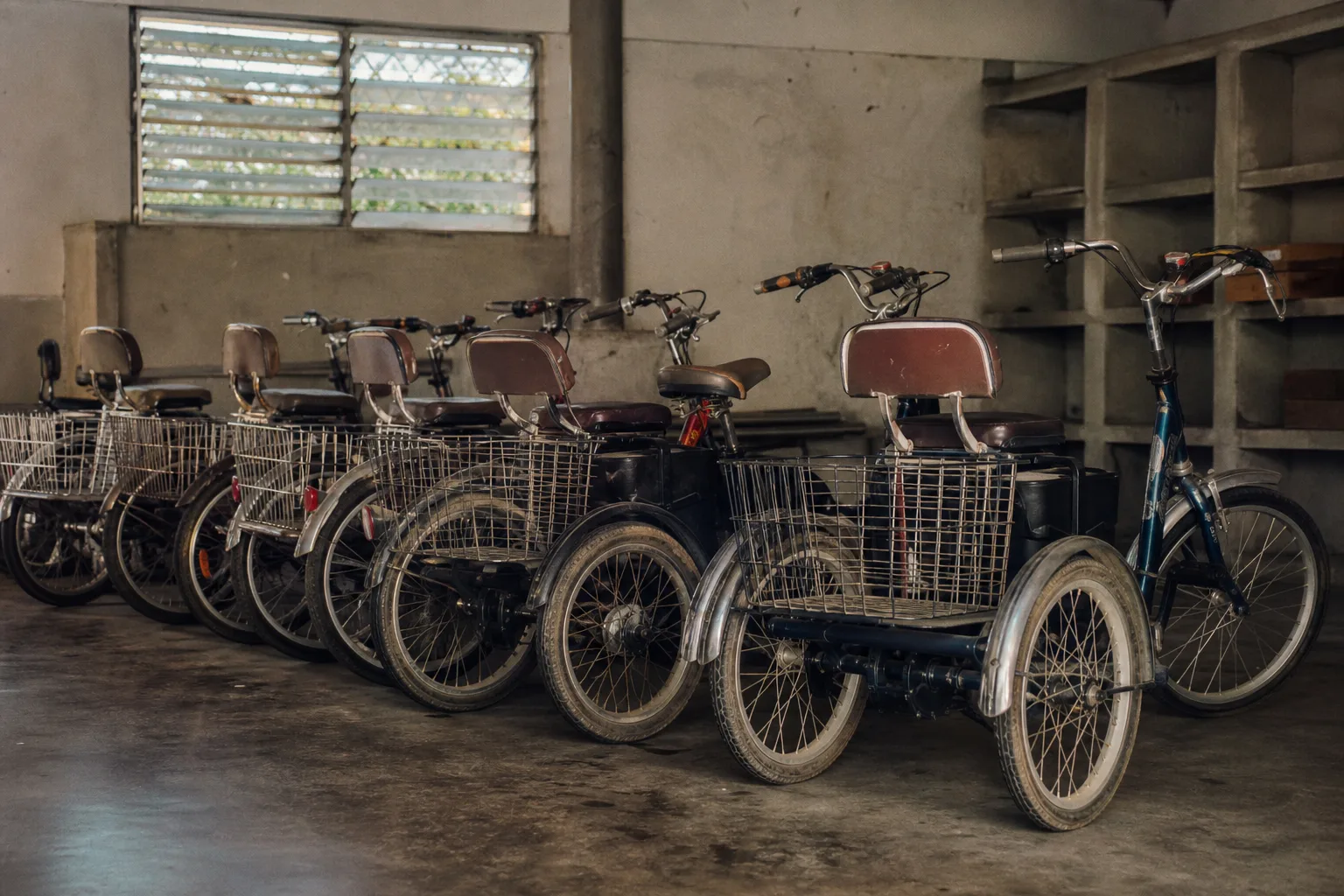
The two rear tires scrub slightly through every turn rather than rolling cleanly, so they wear faster than a bicycle's rear tire does. Budget for replacing both at once.
Levee Top Trikes The rear wheels do not follow the line the front wheel took, so storm grates, gate posts and narrow bike lane pinch points all need a wider mental margin.
The reason most riders start looking at three wheels is not speed and not range. It is the two seconds at a stop sign, foot down, bike leaning, hip taking the load, and the two seconds after that when the bike has to be pushed back up to speed before it will hold itself upright. Those seconds are where a bad knee, a fused ankle, or a repaired hip makes riding stop being worth it. A third wheel deletes them completely. What it does not delete is everything else the bicycle was quietly doing for you.
Standing starts become uneventful. You sit down, you are stable, and you leave when you are ready rather than when the bike demands it, which matters most at driveways, crosswalks and the base of a bridge ramp where a two-wheeler forces a hurried remount. Stopping is the same story in reverse: the machine simply stops and stays put, so you can wait through a long light with both feet flat, hands off the bars, without the small balance corrections that tire an older rider faster than the pedaling does. Loading changes too, since groceries in a rear basket no longer alter how the bike behaves under 4 mph.
The second-order effect is the one riders report after a month, not a day. Because starts and stops cost nothing, trip planning changes. Routes with eight intersections stop being worse than routes with two. Errands that were bundled into one long loop, specifically to avoid dismounting, break back apart into short separate runs. On a flat coastal grid with frequent stops and no hills to bail you out, that difference is most of the reason people ride more after switching, and it shows up in the odometer within the first season.
A bicycle corners by leaning, and the lean is automatic; you have been doing it since childhood without deciding to. A trike does not lean, so the turn is taken by the tires alone, and your body wants to lean into a machine that will not go with you. Take a corner at the speed you took it on two wheels and the inside rear wheel lightens, then lifts. It happens quietly and it happens early, well below any speed that feels dramatic. The fix is simple and entirely learnable: slow before the corner, sit upright or shift your weight to the inside, and hold a wider line.
Camber is the surprise that nobody demonstrates on a showroom floor. Roads are crowned to shed rainwater, and coastal streets are crowned generously, which means a trike ridden near the curb is always sitting on a slope. On two wheels the lean absorbed that. On three, the machine wants to drift downhill toward the gutter and you correct it with steady, low-grade steering pressure the whole way. Driveway aprons, sidewalk ramps and the transition onto a shell or crushed-stone path all present the same problem in a shorter, sharper form. Riders adapt within a couple of weeks; the point is that it is a skill, not a setting.
Then there is width. Two wheels track in one line and three do not, so the rear axle has to clear whatever the front wheel cleared, which changes how you read a bike lane with a storm grate in it, a gate on a levee path, or the gap between two parked cars. It is worth reading a first-person account of what a rider learned in the first month with an electric tricycle before assuming the transition is nothing.
The learning cost is real but short, roughly a few hours of deliberate practice in an empty lot, taking corners at increasing speed until you find where the inside wheel gets light and then staying under it. The equipment costs run longer. Three tires wear at three different rates, because the two rears scrub slightly in every turn instead of rolling cleanly through it, so rear tire replacement comes sooner and comes in pairs. Rear brake pads follow the same pattern. Storage costs change as well, since the footprint is close to double, and a shed or garage bay that swallowed a bicycle upright against a wall will not take a machine that cannot be stood on end.
Consumer bicycle equipment standards in the United States fall under the Consumer Product Safety Commission, and the practical version for a buyer is to check that the frame, the brakes and the battery system were designed together rather than assembled from parts intended for a two-wheeler. Ask specifically about the rear differential or the lack of one, because a single driven rear wheel behaves differently in a turn than a differential does, and that behavior is what you will feel on every crowned street you ride.
Not everyone who is nervous on a bicycle needs a third wheel. If the problem is confidence on loose surfaces, washboard shell paths or the seam between asphalt and grass, a two-wheeler with tires in the two-inch-plus range solves it for far less money and no change in handling habits. If the problem is a slow-speed wobble that appears only when you are tired at the end of a ride, a lower saddle and a shorter stem often fix it. The third wheel is the right answer when the difficulty is structural: a joint that will not take the load of a foot-down stop, a balance disorder, a leg that cannot swing over a top tube, a rider who has already stopped riding because of any of those.
The honest framing is a trade with a favorable balance for the right rider. You give up the automatic cornering you have had since you were seven, and you accept a wider machine, faster rear tire wear and a garage bay that has to be cleared out. You get back the ability to stop wherever you want, start whenever you want, and ride streets you had written off, which for a lot of people is the difference between owning a bike and using one.