Charging on a carport in a hot, humid summer, and what a careful owner checks
On the coast, the battery, controller, and chain all age faster than the frame does. Here is what to check, when to charge, and where the lost range goes.
Choosing, storing and maintaining electric three-wheeled cycles for adult riders in a hot, humid, flat coastal region
- Two separate temperature ranges Manufacturers list one operating range for riding and a narrower one for charging. The charging limit is the one most owners never look up.
- Case color matters A dark battery enclosure in direct afternoon sun runs hotter inside than the surrounding air by a meaningful margin. Shade or a light cover reduces the peak.
- Cooldown before plug-in A pack that just finished a hot ride holds heat in its core for an hour or more. Plugging it in immediately stacks charging heat on top of riding heat.
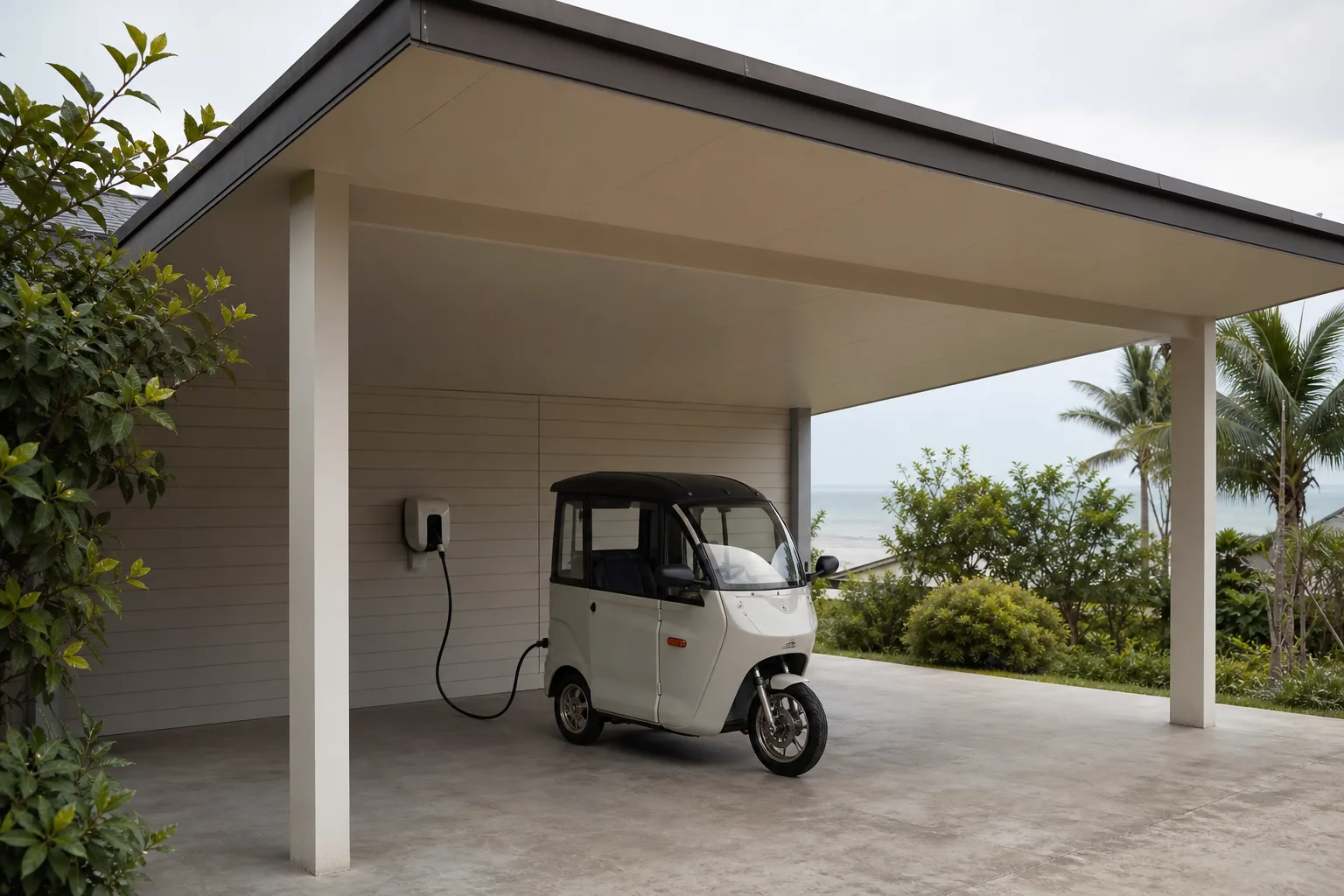
A battery pack that spends June through September on a carport is not stored, it is cooked slowly, and the difference between that pack and one kept at seventy-five degrees shows up years later as capacity you never notice leaving. The frame will outlast all of it. The cells, the controller, the connector pins, and the chain are the parts that record the climate, and each records it differently. What follows is the checking routine that separates a pack still holding most of its original range at the four-year mark from one that quietly stopped making the round trip sometime in year two.
Where the pack actually sits, and what the thermometer under the roof says
Ambient air temperature and pack temperature are not the same number, and the gap is where the damage lives. A dark battery case bolted behind a seat on a west-facing carport absorbs afternoon sun directly, and a closed garage with an insulated ceiling and no ventilation holds heat well past sunset, so the pack may sit above the surrounding air for hours after the worst of the day. Put an inexpensive maximum-minimum thermometer where the battery lives, not in the kitchen, and read it for a week in August. Most riders are surprised. That number, not the forecast, is what should drive where the pack spends the summer.
Manufacturers publish two separate temperature ranges, one for discharge and one for charging, and the charging window is always narrower. Find both in the manual before you decide anything else. Lithium cells tolerate being ridden hot far better than they tolerate being charged hot, and a pack that has just come off a twelve-mile ride in ninety-five degree air is already warm inside its case regardless of what the case feels like to your hand. The Department of Energy is the federal agency responsible for battery and energy storage research, and the practical takeaway from that field is simple enough: heat plus a high state of charge is the combination that ages cells fastest.
The charging window, and why the removable pack earns its price
Wait for the pack to come down to something near room temperature before plugging in, which after a hot ride usually means an hour, sometimes two. Charging in the early morning rather than the late afternoon does most of this work for you at no cost. If the pack detaches, carry it indoors, because a conditioned closet at seventy-two degrees is the single largest improvement available to a coastal owner and it requires no purchase at all. For weeks when the trike sits unused, leave the pack somewhere between forty and sixty percent rather than full, and check it monthly rather than trusting it to hold.
What an afternoon storm does to a controller that was never sealed
Rain that arrives sideways at four in the afternoon does not respect a carport roof, and the controller, usually a finned aluminum box tucked under the frame or inside the downtube, is the component least likely to survive repeated soakings. Look for a stated ingress rating on the controller and on the display, and if the seller cannot produce one, assume the box is splash-resistant at best. Check the cable glands where wiring enters the case, since that is the usual leak path, and check that the drain hole, if there is one, faces down. A fitted cover over the whole trike solves most of this.
Connectors are the slower version of the same problem. Salt-laden air works its way into every multi-pin plug on the machine, and the first symptom is not failure but intermittence: a display that flickers, a motor that cuts for half a second over a bump. Pull the main battery connector and the motor phase connector twice a season, look for green film or white powder on the pins, and treat clean ones with dielectric grease before they need it. Zip-tie the wiring so plugs sit above the low point of the loom, where water drains away rather than collecting.
The chain, and the range you did not know you lost
Chains on the coast rust in days, not months, so the maintenance interval here is set by humidity rather than mileage. Wet lubricant holds up better than dry in this air, and a wiped-down chain after a rainy ride is worth more than any product. As for range, heat costs it twice, once through the pack's own efficiency and once through the higher rolling resistance of soft tires you stopped checking in July. Log your actual round trip in January and again in August. The difference tells you what to plan around.
Owners who check these five things, pack temperature, charge timing, controller sealing, connector condition, and chain state, tend to find their trikes hold range and value well past the point where neglected ones start needing parts.